

Table of Contents
- What Makes Everyday Wardrobe Essentials Work in 2026
- How to Identify High-Quality Clothing Before You Buy
- The Capsule Wardrobe Checklist for a Stylish Everyday Rotation
- How to Style Basic Pieces So They Look Intentional
- Building a Cohesive Color Palette With Neutral Staples
- Sustainable and Ethical Sourcing for Long-Lasting Essentials
- Digital Wardrobe Management and Seasonal Transitions
- Frequently Asked Questions
Last Updated: September 17, 2026
What Makes Everyday Wardrobe Essentials Work in 2026
Building a wardrobe that works every single day comes down to one shift in thinking: stop buying outfits and start buying components. The best tips for stylish everyday wardrobe essentials begin with a simple premise, which is that a small number of well-chosen pieces, worn in rotation, will outperform a closet full of one-off purchases every time. This guide from Smart Universal Suppliers LLC breaks down how to choose those components, what to check before you buy, and how to make basic pieces look deliberate rather than default.
How to Identify High-Quality Clothing Before You Buy
Learning how to identify high-quality clothing comes down to three fast checks: fabric content, stitching, and fit. You can run all three in about a minute, and they will save you from most bad purchases.
Fabric, Stitching, and Fit Checks That Take 60 Seconds
Start with the fiber label. Natural fibers and quality blends hold shape and breathe better than fully synthetic fabrics, though a small amount of stretch fiber in a trouser or denim is normal and useful. Then turn the garment inside out and look at the seams. A clean, dense stitch line with no loose threads or skipped sections signals better construction.
The Capsule Wardrobe Checklist for a Stylish Everyday Rotation
A capsule wardrobe checklist works best when it maps to how you actually spend your week, not to an idealized lifestyle. Count your typical week first: how many days are work-facing, how many are casual, how many need something in between. That ratio tells you how many of each piece to own.
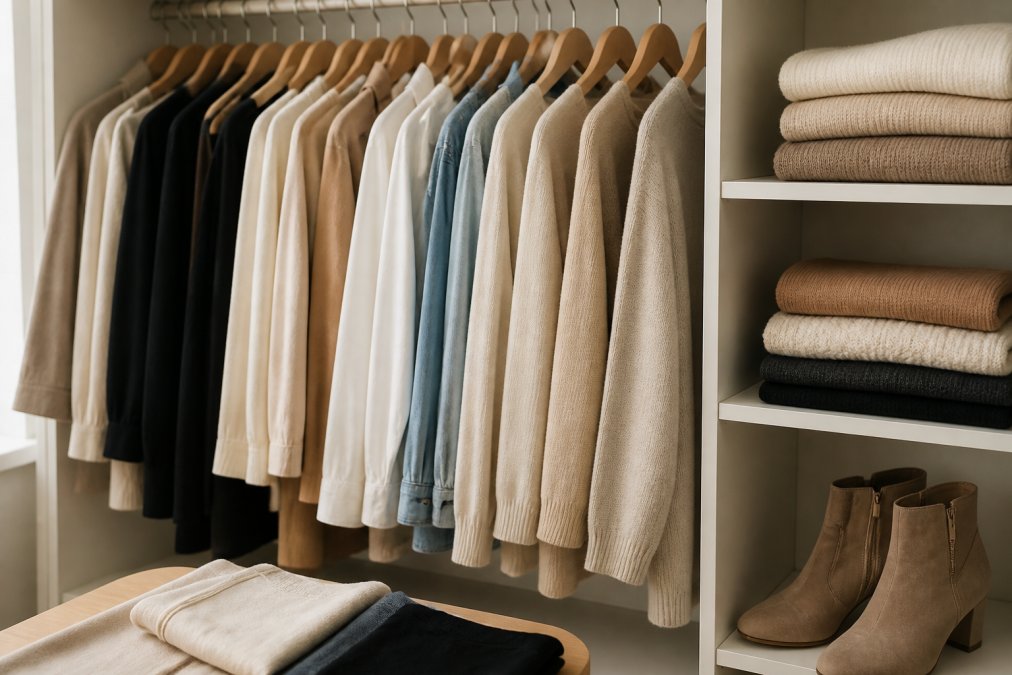
Professional vs. Casual Hybridity in One Closet
The professional and casual split has blurred, and a hybrid closet handles both without doubling your inventory. The trick is choosing pieces that read formal or relaxed depending on what sits next to them. Here is a starting checklist:
- Two button-down shirts in a neutral palette
- One structured blazer or overshirt for layering
- Two tailored trousers, one darker and one lighter
- One pair of well-fitting jeans in a classic silhouette
- Three to four knit tops, including a ribbed hem style
- One trench coat or season-appropriate outer layer
- One pair of ankle boots and one pair of everyday flats or sneakers
- A few essential accessories that repeat across outfits
| Piece | Primary Role | Pairs With | Wear Frequency |
|---|---|---|---|
| Button-down shirt | Smart casual base | Trousers, jeans, blazer | 2-3x per week |
| Tailored trousers | Work and dinner | Shirts, knits, boots | 2-3x per week |
| Classic jeans | Casual anchor | Knits, overshirt, sneakers | 3-4x per week |
| Ribbed knit top | Layering piece | Everything | 3-4x per week |
| Trench coat | Seasonal outerwear | Full rotation | Daily in season |
How to Style Basic Pieces So They Look Intentional
Styling basics so they look intentional is mostly about proportion and repetition, not novelty. When your pieces share a color family and a consistent fit philosophy, even a plain tee and trouser combination reads as considered rather than careless. What most guides skip is that proportion rules change with your silhouette, and the same outfit that flatters one body type can swallow another.
Proportion Rules by Body Type
The goal in every case is to create a clear vertical line and a defined waist or shoulder, whichever your frame responds to. Here is how the same essentials get styled differently:
- Rectangle frame (shoulders and hips roughly equal, little waist definition): create curve with a belted trench, a tucked ribbed knit, or a blazer nipped at the waist. Avoid straight-cut tunics that erase the waist entirely.
- Pear frame (hips wider than shoulders): build volume on top with a structured overshirt, a boat-neck knit, or a blazer with a defined shoulder. Keep trousers straight or slightly tapered, and let the top be the louder piece.
- Inverted triangle (shoulders wider than hips): soften the shoulder line with a raglan sleeve or a dropped-shoulder knit, and add visual weight below with a wider-leg trouser or a midi skirt.
- Apple frame (weight carried through the midsection): use a longline layer, an open overshirt, or a v-neck knit to draw the eye up and down rather than across. High-rise trousers with a flat front work better than a tucked-in top.
- Hourglass (defined waist, balanced shoulders and hips): the priority is not hiding the waist but not burying it. A tucked shirt, a belted coat, or a wrap-style knit all work.
Layering Techniques for Versatility and Texture Mixing
Layering is where a small wardrobe gains range. Pair smooth fabrics with textured ones, like a crisp cotton shirt under a chunky knit, to add visual interest without adding items. Keep the outermost layer the most structured piece so the silhouette holds. For monochromatic styling, work within one color family and vary the texture and tone instead of the hue, which makes a limited palette look deep rather than flat.
Building a Cohesive Color Palette With Neutral Staples
A cohesive color palette starts with two or three neutrals and one accent, then repeats those colors across every category. The difference between a palette that works and one that just looks good on paper is whether you choose your neutrals by undertone, not by trend.
Choosing Neutrals by Undertone, Not Trend
Every neutral sits somewhere on a warm-to-cool spectrum. Camel, cream, ivory, and warm gray lean warm. Navy, charcoal, true black, and cool gray lean cool. Most people look better in one family than the other, and the fastest way to find yours is to hold a warm neutral and a cool neutral next to your face in daylight and notice which one makes your skin look even rather than washed out.
Three Palette Recipes That Cover a Full Week
- Warm base: camel coat, cream button-down, chocolate trouser, tan boot. Accent: rust or olive.
- Cool base: navy blazer, white shirt, charcoal trouser, black boot. Accent: burgundy or forest green.
- High-contrast base: black, white, and one mid-gray. Accent: any single saturated color you already wear.
Pick one recipe and stay inside it for a full season. The point is not variety for its own sake. It is that every piece you own can be worn with at least three others without thinking.
The Three-Item Rule and Cost-Per-Wear Math
A palette is not a restriction. It is a filter that makes every future decision faster and cheaper.
Sustainable and Ethical Sourcing for Long-Lasting Essentials
Sustainable fashion and wardrobe longevity are the same conversation. The most sustainable garment is the one you keep wearing for years, which means buying for durability and repairability rather than novelty. Look for brands that publish their material sourcing, offer repair or take-back programs, and use fibers with a traceable supply chain.
Digital Wardrobe Management and Seasonal Transitions
Digital wardrobe management turns a physical closet into a searchable inventory. Photograph each piece, log the category, color, and fabric, and note what it pairs with. A simple spreadsheet works, and several closet apps do the same job. The payoff shows up at seasonal transition time, when you can see exactly what you own and what gaps remain before you shop.
Frequently Asked Questions
What is the 3-3-3 rule for wardrobe?
The 3-3-3 rule means three tops, three bottoms, and three pairs of shoes that mix and match to create nine outfits. It works as a starting point for a capsule wardrobe because it forces you to pick pieces that share a neutral palette and similar formality. Choose one button-down shirt, one knit top, and one t-shirt, then pair them with tailored trousers, jeans, and a skirt. Add ankle boots, sneakers, and loafers. Every item should work with the other two in its category, which keeps cost-per-wear low and closet organization simple.
What are the essentials for an everyday wardrobe?
A practical everyday wardrobe essentials list includes a button-down shirt, plain t-shirts, a knit sweater, tailored trousers, dark jeans, a trench coat, ankle boots, white sneakers, and one structured bag. These pieces cover smart casual and casual settings without needing constant replacement. Focus on fit and structure over trends. A ribbed hem or boxy fit can date quickly, but a classic silhouette in a neutral palette stays useful for years. Add one or two seasonal transition pieces, like a light jacket, to handle weather shifts.
How can you identify high-quality clothing versus fast fashion?
Check three things: fabric quality, stitching, and fit. High-quality clothing uses natural fibers or dense blends that feel substantial, not thin or slippery. Look at seams: even, tight stitching with no loose threads signals better construction. Check buttons and zippers for weight and smooth action. Then try the garment on and move. If it pulls at the shoulders or gaps at the bust, it will not improve with wear. Fast fashion often skips these checks to hit low prices, which raises cost-per-wear over time.
How do you build a capsule wardrobe from scratch?
Start with a closet audit. Pull everything out and sort into keep, donate, and repair piles. Note what you actually wore in the past month. Then pick a neutral palette of two or three colors and build around ten to twelve core pieces: tops, bottoms, outerwear, and shoes. Use a capsule wardrobe checklist to avoid gaps. Add layering pieces like cardigans or a trench coat for versatility. Test each new item against at least three existing outfits before buying. This keeps the capsule functional rather than aspirational.
What is the 5-4-3-2-1 method for organizing your closet?
The 5-4-3-2-1 method is a packing and closet organization framework: five tops, four bottoms, three dresses or outerwear pieces, two pairs of shoes, and one accessory. It works for travel and for simplifying a crowded closet. The goal is to create a capsule collection where every item pairs with the others. For everyday use, adapt the counts upward but keep the principle: fewer pieces, more combinations. This reduces decision fatigue and makes seasonal transitions faster because you already know what works together.
How do you style basic pieces so they look intentional?
Use fit, proportion, and texture mixing. Tuck a plain t-shirt into mid-rise tailored trousers and add a belt to define the waist. Layer a button-down shirt under a knit sweater and let the collar show. Mix textures like ribbed knit with smooth cotton or denim with silk. Stick to a monochromatic styling approach within one outfit, then add one contrasting accessory. These small moves turn elevated basics into a finished look without buying new clothes. The key is repetition: practice the same three or four combinations until they feel automatic.
Building a stylish everyday rotation is less about buying more and more about choosing well, then repeating what works. Smart Universal Suppliers LLC offers a curated selection of high-quality clothing and lifestyle goods, fast shipping, and a diverse product range so you can fill the gaps in your capsule without bouncing between sites. Shop now with Smart Universal Suppliers LLC and build a wardrobe that earns its place.


